
Help · Guide
How BrandOps9 supports the EU AI Act
What the EU AI Act means for your marketing, and how BrandOps9 is built to help you stay compliant: AI transparency, human oversight, and your responsibilities as the publisher.
BrandOps9 is a transparency-risk AI system
The EU AI Act sorts AI by risk. BrandOps9 generates marketing content, which sits in the lightest regulated tier. It is not “high-risk” (things like hiring, credit scoring or biometrics) and uses no banned practices. That means the rules that apply to it are about transparency and human oversight, not heavy certification. The main transparency rules take effect on 2 August 2026, and BrandOps9 is built around them.
AI content is marked as AI-generated
AI-generated images and video produced in BrandOps9 carry machine-readable “AI-generated” provenance metadata, so platforms and detection tools can recognise them as synthetic. And the support assistant, Emma, tells you up front that she is an AI, so you always know when you're talking to a person versus a model.
A human stays in control
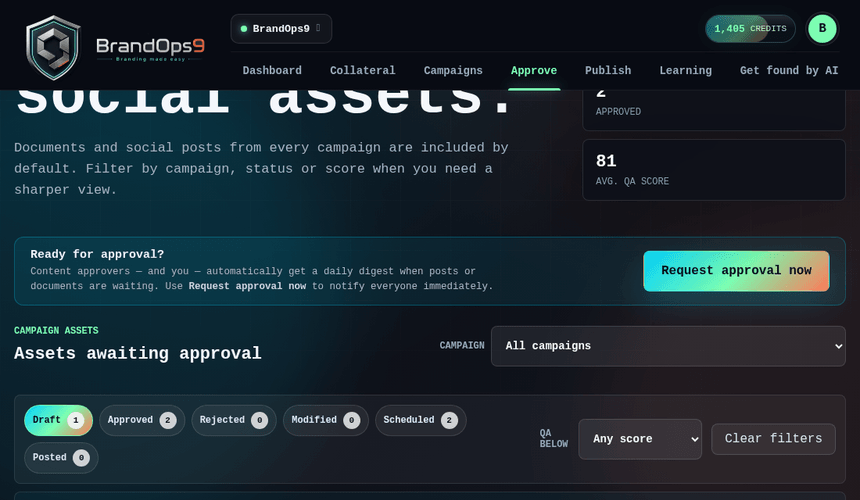
In the standard workflow nothing publishes until a person approves it. The Approve screen is the deliberate gate between “generated” and “published”, with a QA score on every item so you can judge quality before it goes out. Keeping a human in the loop is exactly the kind of oversight the Act values, and it means you, not the tool, hold editorial responsibility for what you publish. See “Approve, reject and request approval”.
Autopilot and your responsibility
Autopilot can generate, approve (against a quality score you set) and publish content automatically, without reviewing each post by hand. That's a real convenience, but it removes the per-item human check, so when you enable Autopilot, BrandOps9 asks you to confirm that you accept editorial responsibility for what it publishes. You stay the responsible publisher either way.
Your responsibilities as the publisher
Under the Act, the business that publishes content is the “deployer” and carries a few transparency duties for what it puts out. In practice: if you publish AI-generated or manipulated images, audio or video that depict real people (“deep fakes”), or AI-generated text that informs the public on matters of public interest, you may need to disclose that it's AI. Don't use BrandOps9 to create deceptive deep fakes of real individuals. For ordinary product and brand marketing, these duties rarely bite, but they're yours to judge for your content.
Your data and the AI models
To generate content, relevant brand and campaign context is sent to our AI sub-processors: OpenAI (text, image and video) and, if you enable it, RunwayML (video). That data is used only to produce your requested output and is not used to train those providers' models. Generation may transfer data outside the EEA under standard safeguards. The full picture is in the Privacy Policy and Terms.
Good to know
This guide explains how the product is designed to support compliance; it isn't legal advice. The AI Act's detailed transparency guidance is still being finalised, so specifics may evolve, and your own obligations depend on what and where you publish. If compliance is critical for you, have your own counsel review your usage.