
Help · Guide
Collateral: your proof, and how to create it
What collateral is, why it's the credibility behind your campaigns, and how to create it, generated or imported.
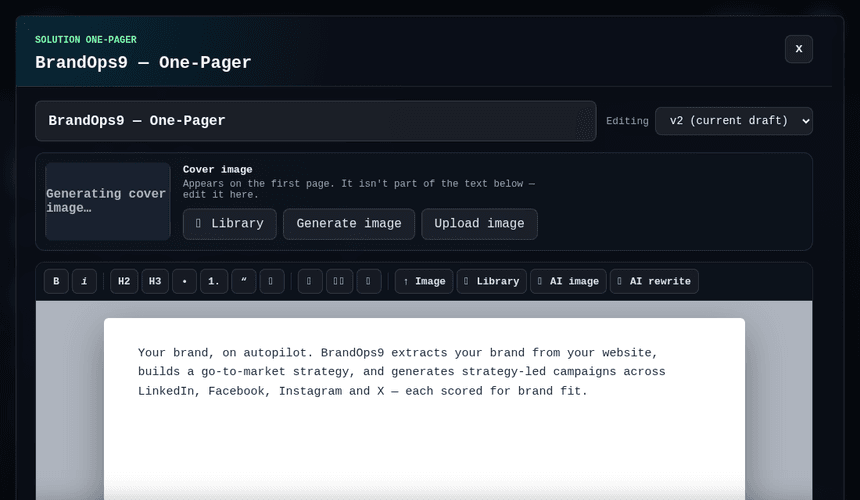
What collateral is
Collateral is your long-form, substantive content: one-pagers, case studies, guides, checklists, FAQs. Where a social post is a short hook, collateral is the depth behind it: the document that actually makes the argument, shows the proof, and stands on its own. It's the difference between saying “we're great” in a post and having a one-pager that demonstrates it.
Why it's the proof behind your campaigns
Campaigns make claims; collateral is what backs them up. When you link an approved document to a campaign, BrandOps9 treats it as proof: the campaign's posts are generated grounded in that real, approved material, so they stay specific and credible instead of vague. A campaign with strong collateral behind it reads as evidence-led; one without it leans on adjectives. It's the same principle as proof points in your strategy, scaled up to a full document a prospect can actually read, download or be handed by a salesperson.
How to create collateral
Open the Collateral area and start a new document. You have two routes:
- Generate it: pick a type and topic and BrandOps9 drafts an outline, then a full document written against your brand voice and strategy. Review the outline first, then let it write the draft.
- Bring your own: import an existing document and BrandOps9 brings it on-brand.
Edit, approve, and put it to work
Refine the draft in the editor (it versions as you go and gets a QA score, like any content), then approve the version that goes live. Once approved, link it to a campaign as proof, share it with clients through the review portal, or surface it in your curated content library for reuse. See “Collateral versioning” for how editing and versions work, and “The power of proof points” for the strategy-level building blocks.